
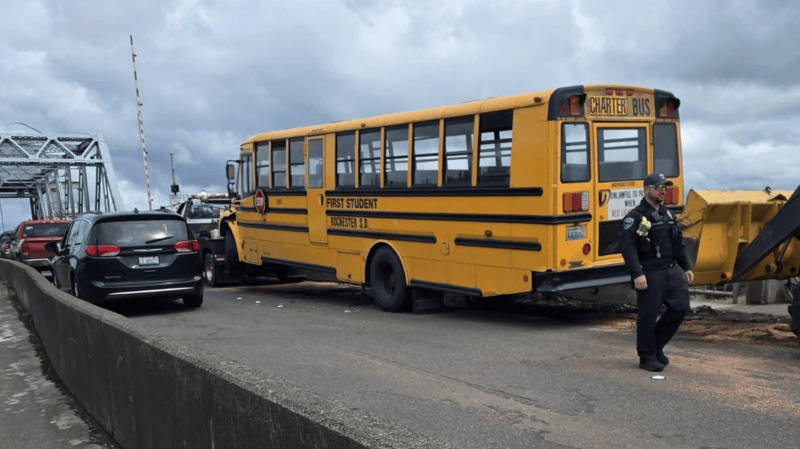
When a school bus from outside the area collided with a barrier on the US 101 Simpson Avenue Bridge several weeks ago, it caused significant traffic disruptions throughout the Harbor.
The bus struck the bridge barrier and became lodged on the structure, forcing officials to partially close the bridge for an extended period. While emergency crews were able to reopen one lane of traffic relatively quickly, the reduced capacity created lengthy delays for motorists traveling between Aberdeen and Hoquiam.
As traffic backed up throughout both cities, many frustrated community members turned to social media, including the Grays Harbor Scanner page, asking why officials did not redirect traffic and open the Riverside Avenue Bridge to accommodate two-way travel during the incident.
To answer those questions, Grays Harbor Scanner reached out to both the Hoquiam Police Department and the Washington State Department of Transportation (WSDOT).
Advertisement

Local Authorities Don't Have the Authority to Reverse Bridge Traffic
Interim Hoquiam Police Chief Jeff Salstrom explained that decisions involving reversing traffic flow on either of the Harbor's state highway bridges fall under WSDOT's jurisdiction.
"Because reversing traffic on the Riverside and/or Simpson bridges is the purview of the Washington State Department of Transportation, I believe it would be more appropriate for them to provide comment on the issue. The city does not have the authority to implement a reversal of traffic on state highway bridges, nor do we have the staffing or equipment to safely set it up."
Chief Salstrom's comments echoed information Grays Harbor Scanner had already been sharing with readers during the incident.
What Does WSDOT Say?
According to WSDOT, during the school bus collision, one lane of travel remained open on the Simpson Avenue Bridge for most of the incident. The bridge was only fully closed for brief periods while emergency crews worked and while the bus was removed from the scene.
However, if a complete and extended closure of the Simpson Avenue Bridge were to occur, WSDOT says the Riverside Avenue Bridge could be reconfigured to carry two-way traffic.
Where Would the Response Crews Come From?
WSDOT officials explained that most emergency responses are handled by crews from the agency's Aberdeen maintenance facility.
For planned full bridge closures, however, a specialized regional traffic control team is often brought in to establish and manage the detour route. Those teams are based in Thurston County.
Response times can vary depending on several factors, including whether crews are already available locally, are working on another project, or must be called in after normal business hours.
How Long Does It Take to Set Up a Two-Way Traffic Detour?
According to WSDOT:
- Planned closures typically require 1 to 2 hours to establish a detour route and traffic control system.
- During an emergency, setup can take 3 hours or more, depending on the time of day and available resources.
- Heavy congestion created by the incident itself can further increase the amount of time needed to deploy traffic control equipment and personnel.
How Long Does It Take to Restore Normal Traffic Flow?
WSDOT says returning the bridges to their normal traffic patterns generally takes about half the amount of time required to establish the detour.
The agency emphasized that its goal during emergency incidents is to keep at least one lane of travel open whenever possible. During the school bus collision, one lane remained open for most of the response, with only temporary closures required for emergency operations and towing of the disabled bus.
The Bottom Line
While many drivers questioned why Riverside Avenue Bridge was not immediately converted to two-way traffic during the bus crash, officials say the process is far more complex than simply changing traffic direction. Such a change requires WSDOT authorization, specialized traffic control plans, equipment, and personnel to safely manage traffic flow.
In this case, because one lane of the Simpson Avenue Bridge remained open for most of the incident, officials determined that maintaining limited traffic flow was the safest and most practical option while crews worked to clear the scene.
Advertisement